Worried about choosing the wrong dive knife? You’re not alone. Many divers struggle with subpar knives that rust, break, or fail in emergencies. Don’t let this be you. Explore our guide to find the most reliable dive knives crafted for underwater safety and performance.
Best Dive Knives

SEAC Samurai, Scuba Diving Knife with 7 cm Stainless Steel Blade
- Sheath in shockproof plastic with wrist strap
- Knife length: 150 mm. Blade Length: 70 mm
- Blade in hardened and polished stainless steel for maximum corrosion resistance
- Available in different colours

SEAC Unisex Rapid Daga Safety Knife for Diving and Underwater Fishing Stainless Steel 10 5 cm, Black, standard UK
- SEAC rapid daga is ideal for those looking for an underwater knife for scuba diving, free diving and SP ear fishing
- "Dagger" Blade in 10.5 cm stainless steel, with a smooth edge and a serrated edge for half the length. Total blade + handle: 23.5 cm
- Small steel handle butt, useful for producing noise - BEATING it on the tank- and attracting the attention of other divers. The release button is also located near the handle attachment
- The scabbard is rigid and makes it possible to hook the diving knife on both sides. The SEAC rapid daga scabbard can be fastened to the belt through the slots, or on the arm or calf thanks to the two straps included in the package

pistro Dive & Surf Safety Twin Line Cutter | PP Handle + Sheath | Carbon Steel Blade for Scuba Diving, Fishing Nets - Orange
- 【Instant Line Severing】Industrial-grade carbon steel blade slices through 10mm ropes/fishing nets/kelp in one motion - sharper than titanium with saltwater corrosion resistance.
- 【100% FingerSafe Design】Recessed blade + safety lock prevents accidental cuts (tested with 7mm gloves). Shatter-proof PP body withstands 200m depth pressure.
- 【Multi-Mount Convenience】Includes 5cm-webbing compatible sheath + heavy-duty strap. Secure to BCD vests, weight belts, or arm bands in seconds.
- 【Emergency-Ready Kit】Ultra-flat 0.3" profile (10x3.5x0.8cm) fits in pockets/PFDs. Complete with drainage-vented nylon pouch - weighs less than 2oz.
- 【All-Water Utility】Trusted by surfers (wave entrapment), divers (fishing line snags), and kayakers (hydrilla removal). 4 color options for visibility.

Diving Knife, Ti Alloy Diving Line Cutter Rescue Tool with Storage Pouch
- Ti Alloy Construction: Crafted from Ti alloy, extremely sturdy, this diving line cutter is suited for saltwater environments, as the material maintains its integrity over time without significant degradation.
- Serrated Cutting Blade: The diving cutter features a serrated blade designed to grip and slice through monofilament line, nets, or thin cables with a pulling motion, which can be more manageable than a straight blade in moving water. The teeth help prevent the line from slipping during the cut, allowing you to address entanglements with a focused effort.
- Extended Grip Handle: With a longer handle, this diving safety cutter gives you greater leverage and control, making it easier to position the blade accurately when wearing thick cold-water gloves that can reduce dexterity.
- Essential Safety Function: This diving rescue cutter is intended as a preparedness tool for dealing with accidental encounters with abandoned fishing line or underwater vegetation, helping divers address entanglements that could pose a risk.
- Secure Storage Pouch: Included with the survival knife is a compact pouch that helps protect the blade and provides a way to attach the tool to your BCD harness, dive belt, or calf strap for consistent placement.
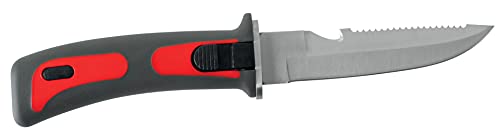
SEAC Bat, Scuba Diving Knife with Safety Grip, Stainless Steel 11.5 cm
- 11.5 cm AISI 420 stainless steel standard blade. Total length 23 cm.
- Curved side of the blade with smooth edge. Straight side of the blade serrated with line cutter.
- Non-slip grip thanks to the overmolding that covers it and increases its grip.
- Rigid scabbard to attach to the arm or forearm thanks to the practical straps supplied. The release button is integrated into the handle.
- Warning It is recommended to always rinse with fresh water and to dry well with a cloth or absorbent paper both the knife and the scabbard separately and after each dive, even if the knife was only worn and not used, since the scabbard is not watertight.
Checklist: What makes a great Dive Knives
- Material Quality: Opt for dive knives made from corrosion-resistant materials such as stainless steel or titanium to withstand the harsh marine environment. This ensures durability during water sports activities.
- Size and Weight: Consider a dive knife that balances size and weight for easy handling and storage. Compact designs are preferable for attaching to equipment or storing in pockets during both recreational and professional dives.
- Blade Type: Choose between straight, serrated, or combination blades depending on your specific cutting needs. A serrated edge is excellent for cutting rope and other fibrous materials commonly encountered in water sports.
- Grip and Handle: Ensure the knife has a non-slip, ergonomic handle for secure grip even when wet. This enhances safety and usability, preventing accidents while participating in water sports.
- Sheath and Mounting Options: A reliable sheath with versatile mounting options is essential for safely carrying your dive knife. Look for models with leg straps, belt clips, or hoses attachment for easy access underwater, making it as indispensable as your dive watches.
FAQ
What materials are best for dive knives to prevent rust?
Corrosion-resistant materials like stainless steel or titanium are ideal for dive knives, as they ensure durability and withstand the harsh marine environment, preventing rust.
Why is the size and weight important when choosing a dive knife?
The right size and weight ensure easy handling and storage, making the dive knife convenient to attach to equipment or keep in pockets during dives.
How important is the handle design for a dive knife?
A non-slip, ergonomic handle is crucial for secure grip, especially when wet, enhancing safety and usability while participating in water sports.